
Most of us already know about the basic sunscreen tips, e.g. reapply every two hours, etc. This blogpost intends to discuss deeper issues that are equally important. Some of these issues can be really, really technical (if you read published literature on it, you'll know what I mean). Since this is meant to be an introductory post for the average, non-skincare-fanatic girl, I've done a lot of oversimplification, in order to get the points across. And to make it more entertaining (a long block of text is boring after all), I've even thrown in cute pin up girls with lame captions. So without further ado, here are my 5 tips:
1. Just Looking at the SPF Number is Not Enough
It always surprises me how most people think that as long as a sunscreen's SPF (Sun Protection Factor) is high enough, they're covered. Not quite - there are two types of ultraviolet rays produced by the sun that hit the skin - UVA, and UVB (there's also UVC, but that's absorbed by our ozone layer, so you don't have to worry about it). Both UVA and UVB damage the skin - they can damage collagen fibres in the skin, as well as cause free radical damage. UVA however, doesn't cause sunburn, whereas UVB does. It's a lot more complex than that, but I'm oversimplifying here.
Now, the SPF number in a sunscreen is only the measure of protection against UVB rays. Basically, the higher the SPF, the greater the protection you get against UVB rays. Of course, this leaves out half the story - you don't know anything about whether the sunscreen can offer protection against UVA rays. So even if you slather sunscreen all over your body, if it doesn't have much UVA protection, you will still subject yourself to sun damage. In fact, you may be worse off, because you won't burn as quickly despite exposure to UVA rays, thus you may end up staying out in the sun for longer.
So how do you determine whether a sunscreen has good UVA protection or not? This is where it gets tricky. Unlike SPF, which is pretty much well-defined the world over, there is no universal standard for UVA protection. In some countries, typically in Asian countries, you see a PA value, e.g. PA+, PA++, PA+++ and so on. This is an indication of UVA protection, and the more ++'s after the PA, the higher the UVA protection. You see this a lot on Japanese sunscreens. In my experience, I rarely see any sunscreens beyond PA+++. In other countries, such as some European ones, they use PPD (Persistent Pigmentation Darkening) as a measure, followed by a number, e.g. PPD 4, PPD 8, PPD 12 and so on (I don't often see sunscreens with more than PPD 12). Like SPF, the higher the PPD value, the greater the UVA protection. In the USA and other countries (see Edited to add note a few paragraphs down for US FDA sunscreen guidelines changes), there isn't any standard way to label UVA protection, so most sunscreens will mention something like "broad spectrum protection" on the packaging. If, in the absence of PA or PPD information, you see this, it's generally a good indication that it has some protection against UVA rays too. So the bottom line is - don't just look at the SPF number. Check to see that it offers UVA protection too.
1a. A side note: SPF Numbers Can be Misleading
So now that you're aware about choosing a sunscreen with broad spectrum protection, I'd like to clear up one last misconception about SPF. In Asia especially, girls like to go for crazy high SPF numbers in their sunscreen (here you see SPF 130 sunscreens and SPF 100 sunscreens quite commonly). They somehow feel like it's the strongest type of sun protection they can get. However, a higher SPF doesn't really mean a higher level of protection - past a certain point, the additional protection offered is less and less, as sun protection protection doesn't increase linearly with SPF number. So a SPF 30 sunscreen will have a greater incremental effect when compared to a SPF 20 sunscreen, but an SPF 80 sunscreen may not be all that much different from a SPF 70 sunscreen. And, a SPF 100 sunscreen does not actually offer twice the amount of protection that an SPF 50 sunscreen does. Case in point - an SPF 15 sunscreen absorbs 93% of UVB rays. An SPF 30 sunscrreen absorbs 97% of UVB rays. An SPF 50 sunscreen? 98%. That's why some countries (mainly European ones, and most recently the USA) have regulations demanding that you can't label your sunscreen with a number above, say, SPF 50, becuase the SPF number can be misleading for the average consumer. In these countries, anything above SPF 50 will just be labelled SPF 50+. But where I live, companies go crazy advertising uselessly high SPF numbers, and ignorant consumers snap these up like candy.
Updated to Add: Here's a handy chart. As you can see, the sky-high SPF value really confers only incremental benefits when it comes to sun protection, once you hit SPF 30 (which provides 97% protection). So, if you're thinking of spending top dollar on that SPF 20000 sunscreen, just opt for an SPF 30. I personally use SPF 50 for my daily use, but then again I'm an Asian girl aspiring to Twilight-vampire-like pale skin. So there.

But anyway, enough about my rant. Let's move on to the next point.
(Edited to add: I must have a sixth sense or something, because a couple of months after I wrote this article, the FDA unveiled some changes to sunscreen guidelines, which would affect the claims manufacturers can place on their packaging. This includes making it mandatory for sunscreens to offer effective UVA and UVB protection in order to claim being "broad spectrum", and requiring any sunscreen with SPF values of more than 50 to be marked SPF 50+. That's better, isn't it? You can read more here.)
(More Edited to add: This isn't really in the scope of an introductory blogspot, but this really interesting blogpost has further info on why SPF numbers can be misleading - basically he argues that other ingredients (namely antioxidants and anti-inflammatory ingredients) can skew the SPF measurements by making them seem higher than they really are. The bottom line is to look not just at SPF number, but also at the level of UVA protection offered.)
2. Know Whether Your Sunscreen is Physical or Chemical
Sunscreens offer protection in two ways - physical, and/or chemical. A sunscreen can be purely physical, purely chemical, or both. Physical filters utilize ingredients (there are really only two, titanium dioxide and zinc oxide) to reflect and scatter the sun's rays. So basically, these ingredients sit on top of your skin, and deflect the sun's rays away from your skin (I oversimplified, but you get the idea). So they physically block the sun's rays. Chemical filters (avobenzone, octocrylene etc) work differently. These absorb the incoming UV rays, and then "convert" them to heat (another oversimplification, but I hope it makes things clear).
So, you may ask, what's the difference between the two? Well, physical sunscreens are less cosmetically elegant - so if you get that white cast on your face, it's usually due to the physical filters in your sunscreen. In addition, physical sunscreens tend to be thicker, and more opaque, and thus tend to have a heavier texture, which some people don't like. On the bright side, they are generally more photostable, and they are generally agreed to be less likely to aggravate sensitive skin. Chemical sunscreens tend to have a better texture, as they tend to be colourless and more watery in texture (a lot of Japanese sunscreens are like this), and don't give you "white sunscreen face", but on the other hand, they tend to aggravate some types of sensitive skin more. Some badly formulated ones can sting and burn sensitive skin. (There's also a concern about chemical sunscreens being xenoestrogenic, but I won't go into that, as I don't have much expertise in the area.)
Thus, if you do have sensitive skin, it is a good idea to look out for a physical sunscreen. Often I get feedback from my female acquaintances telling me about how this or that sunscreen cause them skin sensitivities, and when I check, they're invariably using a sunscreen that's heavy on the chemical filters. Of course, this is an over-generalization because everyone's skin is different, and there are lots of ways to formulate sunscreen (the base, in addition to the active ingredients, could contain irritating compounds). But if you have sensitive skin, it's worth bearing in mind. The bottom line - there's a tradeoff between cosmetic elegance and skin aggravation. You have to find the balance, and it starts by knowing the difference between physical and chemical filters.
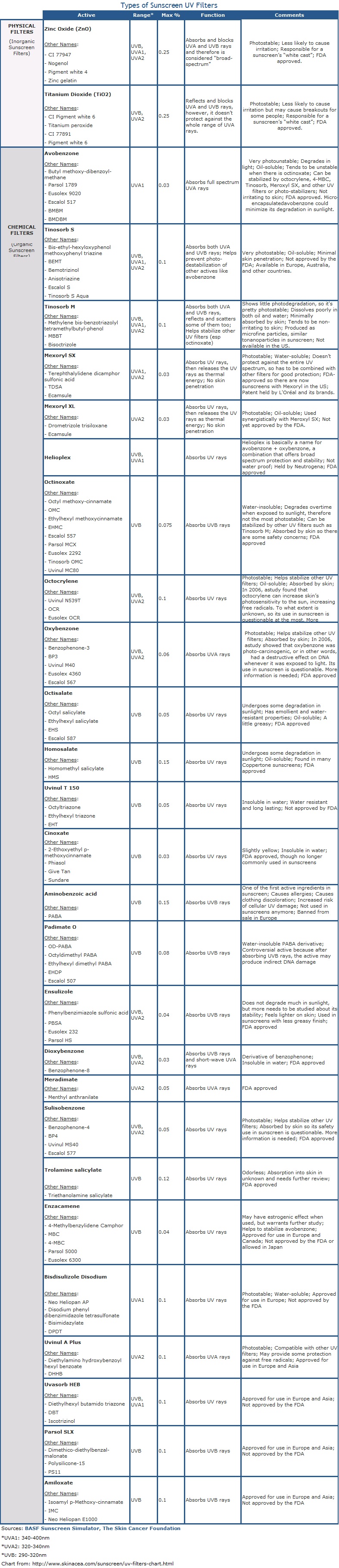
Updated to add: So as far as choosing sunscreen goes, a good idea is to look out for two things: a sunscreen with both UVA and UVB protection, as well as a sunscreen whose filters, whether chemical or physical, are less likely to aggravate your skin. Here's a neat chart that summarizes some of the commonly used sunscreen filters, whether they are chemical or physical (like I said, there are only two physical filters), as well as the level of UVA and UVB protection they provide.
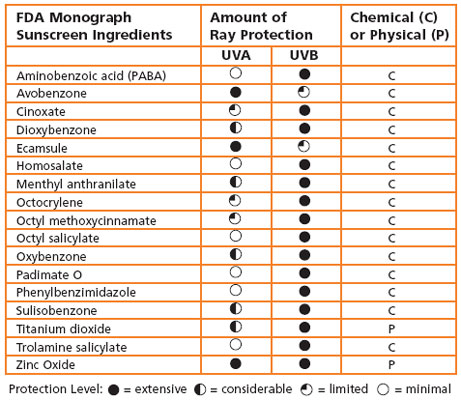
If the above list sounds very short, it's because the FDA only lists down the INCI names, not the brand or trade names these are sold or marketed under. For example, Helioplex (you may have seen it on Neutrogena sunscreens) is actually a combination of avobenzone and oxybenzone, not an entirely new sunscreen filter altogether. Also, as this is a chart from the FDA, it doesn't include filters approved elsewhere (e.g. Europe) that have not yet been approved by the FDA. For a list of some of these, you can see here (or scroll down to the end of this post, where I have the table in a picture form in the annex).
3. Layering SPF Products Does Not Work
Another common question I get is, "If I use an SPF 15 moisturizer, and an SPF 20 sunscreen, will I get SPF 35 on my face?" I hate to break it to these girls, since I see so many people doing this, but the answer is no. Then said girl will invariably ask, "Or is it just SPF 20, since that's the higher of the two?" Once again, no.
The reason why SPF 15 + SPF 15 doesn't = SPF 30 is because some SPF ingredients can interfere with each other, or stabilize each other. This has to do with issues of photostability in the sunscreen. Some ingredients degrade other ingredients, thus offering less protection overall. A commonly-cited example is uncoated titanium dioxide or zinc oxide degrading avobenzene. In other words, if you have a sunscreen containing zinc oxide, and another sunscreen containing avobenzene, it is not a good idea to use them together or layer them on top of the other. Other ingredients, on the other hand, stabilize each other - for example, avobenzene is stabilized by specific amounts of octocrylene, so they are often used together in sunscreen formulations.
The reality is, it's hard to tell how a sunscreen will react with another sunscreen, unless you know specifically what the active ingredients are, and how they would react with each other. But we aren't all PhD holders. So the easiest way is to just have only ONE product with SPF in your routine (that is, the sunscreen) and apply that properly. That way, you can be sure it won't have any other sunscreen ingredients to interfere with its effaciacy. Don't get a moisturizer with SPF, a foundation with SPF, and try to layer them both with a sunscreen. That's just a waste of all that sun protection in the product.
(On a side note, this is why I absolutely HATE moisturizers and foundations with SPF protection. They get in the way of my sunscreen. Unfortunately, every other new moisturizer or foundation has SPF inside, thanks to the laws of supply and demand. Stupid uninformed consumers demanding SPF-infused products which shouldn't have SPF stuff inside. Grr.)
Which brings me to my next point.
4. Apply Your Sunscreen Properly
I'm always amazed by girls who spend a pretty penny on their sunscreen, but can't be bothered to apply it properly. I mean, if you're going to apply it at all, make sure you do so properly, if not you won't get the full protection of your sunscreen. There are two major issues with application that I will go into: not applying enough, and excessive rubbing.
4a. Not applying enough
Do you know how SPF is calculated? It's calculated by measuring the amount of UV protection afforded by the sunscreen, using 2mg of sunscreen per cm2 of skin area. Yes, 2mg/cm2. Use any less, and you'll be getting less than the stated SPF on the bottle.
So, what does 2mg/cm2 of sunscreen look like on your face? This should translate into half a teaspoon for your face and neck, and half a teaspoon for each arm (this is an approximate measurement, and would vary with the surface area of your face/neck/arms). Most people I know don't use anywhere near to the correct amount of sunscreen, even though they buy really expensive sunscreen products. That's a pity. Remember, always use at least half a teaspoon. If in doubt, use more rather than less. How much you use determines how much protection you get.
Now, on to the next mistake when it comes to sunscreen application.
4b. Rubbing Your Sunscreen
Sunscreen is supposed to sit in an even, unbroken layer across the surface of your face. That's how it reflects/scatters/absorbs the UV rays before they hit your skin. So when applying your sunscreen, that should be your aim. Rubbing or buffing in your sunscreen will break the even layer across your face, and affect its effectivenss. I know the temptation to rub it into your skin can be strong, but yes, it is supposed to sit on top of your skin to work properly. It's sunscreen, not skincare.
As a corollary, it also irritates me when people put on sunscreen, and then buff or rub their foundation on top of the sunscreen. By doing so, the sunscreen's efficacy has been lessened. I guess for people who use makeup on top of their sunscreen, rubbing and buffing will be inevitable - the only tip then would be to keep the rubbing to a minimum.
Both points 3 and 4 above bring me to my last point which is...
5. Sunscreen in Non-Sunscreen Products is Useless
Well, not quite useless. But generally, unless these products are used and applied like sunscreen, you aren't likely to get much UV protection from these products. And by "used and applied like sunscreen", I mean 1. applying as much of the product as you would sunscreen (remember, 2mg/cm2), and 2. Not rubbing or buffing it into your skin, and 3. not layering products.
Now you see why sunscreen in non-sunscreen products, like moisturizers, foundations, and powders, is so useless. First of all, noone applies 2mg/cm2 of foundation to their face. You'd end up with a very cakey makeup look - not great. Same for moisturizer and powder. So in reality, although SPF 15 in that foundation may sound great, unless you apply half a teaspoon of foundation for face and neck, you're not getting anywhere close to SPF 15. In fact, this post on Futurederm (written by Nicki who is herself a med student) estimates that "your average SPF 15 powder is giving you a true SPF of 1.1, and your SPF 15 moisturizer is giving you actual protection of SPF 8 to 10 with average application".
(Edited to Add: If half a teaspoon seems hard to visualize, here's a really good post on FutureDerm written since the time this blogpost went live, where John pours out the requisite amount of sunscreen into his palm (he's using approx a quarter of a teaspoon, calculated on the surface area of just his face only, not including the neck). Now imagine that you want to get your full SPF20 from your foundation. Are you really going to apply that much foundation? I definitely wouldn't want to use that much foundation on my face - it would be too much makeup.)
The second issue is to do with buffing and rubbing. When you use moisturizer, foundation, or powder, or other makeup product, you're supposed to buff and rub. I mean, a skilful makeup application means lots of blending, right? Unfortunately, it also makes for very lousy SPF coverage. This means to get SPF 15 of coverage listed on your foundation, you'd have to use half a teaspoon of foundation, and try not to blend it in. Eeks.
Lastly, of course, you can't layer SPF products (or you can, but the active ingredients may interfere with each other). I've already written about this, so I won't go into details again. So now you can see why I hate foundations, powders, moisturizers, etc with sunscreen in them. They're really more a marketing gimmick than anything else, since most people would use these products in a manner which would render very little, if any, UV protection at all.
So there you have it, the five most useful sunscreen tips I've ever encountered. I know I've oversimplified here and there, sometimes a lot, but I hope that it makes some of these very technical issues a little easier to understand, so if anyone wants to chime in with their two cents worth, please do so and leave a comment! There's lots of scientific literature out there, so if anyone wishes to delve deeper into any of the abovementioned points, there's a lot of reading (the Skincare board on Makeupalley is a great place to start). Good luck, and happy sunscreen-ing yourself!
Annex: Full List of Sunscreen Filters
This super long list of sunscreen filters, as well as details about them, are from Skinacea. I'm keeping a copy on my site because things on the internet aren't very permanent, and we absolutely need this valuable resource!







I wonder if the applying sunscreen over sunscreen is a no-no rule also applies when my sunscreen, make-up and powder are all physical, i.e. zink oxide and titanium dioxide. Any thoughts on that?
ReplyDeleteAnd while I'm at it, thanks SO MUCH for this! Just yesterday I was telling a German beauty blogger that SPF in her face cream is not enough to protect her.
@Julia: It's very hard for me to say what will be the interaction. Even with physical sunscreen (Zinc/Titanium Dioxide) there are different types, e.g. particle sizes can be different, and that some brands "coat" their zinc/titanium dioxide, and some brands leave them "uncoated" (so if you see references to "micronized", "coated" or "uncoated" zinc/titanium dioxide, they're likely referring to these specific properties of their ingredient). My layman's understanding of physical sunscreen is that particle size and whether an ingredient is coated or not is an important factor towards determining how much coverage you have. I do not know if mixing various types of physical sunscreen, with potentially differing particle sizes and different coatings, will affect the protection you get. But yes, as an overgeneralization, I would imagine that there would possibly be less reactions than trying to layer physical and chemical sunscreens.
DeleteAnd thanks for your kind comment - I'm glad you found it useful!
Very interesting, thank you!
ReplyDeleteIf applying makeup over your sunscreen is not recommended, and you don't recommend using makeup/skincare products with spf as protection, then how are you supposed to get facial sun protection?
ReplyDelete@Anonymous: You can use sunscreen directly on your face. If the skin on your face is sensitive, you may wish to explore brands with physical sunscreens that are gentler on the skin - a lot of European brands (Avene, La Roche Posay, etc) are quite famous for their sunscreen, and I personally use Avene directly on my face (depending on the sensitivity of your eye area and the sunscreen, you may or may not wish to use sunscreen near your eye area).
DeleteIf you wish to layer your makeup over your sunscreen, nothing is stopping you. However, just be aware that excessive buffing and rubbing will decrease your sunscreen's protection. As mentioned in the blog post, if you choose to wear makeup over sunscreen, then rubbing will be unavoidable, but keeping it to a minimum will help to preserve some of the sun protection. Also, it will help to pick makeup items without SPF if you are going to layer them over a sunscreen.
So, for facial sunscreen protection- ideally I should wear sunscreen and no foundation/concealer/powder/blush? I have very sun-sensitive skin, and my everyday routine is cleanser/salicylic acid gel/liquid physical sunscreen/liquid concealer/powder/blush. But I gather that I'm compromising the efficacy of my sunscreen?
Delete@Anonymous: Ideally, sunscreen alone is the best protection, because layering makeup over it will disturb the sunscreen layer below somewhat. Still, in real life it may not be that practical to do so, so even if you do put makeup over your sunscreen, it's fine - you may be compromising the efficacy of your sunscreen somewhat, but it's still better than not wearing sunscreen at all. Hope this helps!
DeleteWhat are examples of physical sunscreens that don't leave globby white streaks? I'm as pale (or more) than the average midwestern, but one sunscreen I have makes me look like a clown! My skin isn't that sensitive, so I suppose I should just stick to chemical sunscreens.
ReplyDelete@Leah: Physical sunscreens have improved significantly in their formulations with the use of micronized titanium or zinc oxide as active ingredients. Micronized just means the zinc/titanium oxide particles go through additional processing to give them a smaller particle size, which makes them more cosmetically elegant, and thus less likely to leave a white cast. I can't think of any examples offhand right now, but you can try looking for a sunscreen that uses micronized zinc/titanium oxide.
DeleteIf your skin isn't sensitive and you'd like to use s chemical sunscreen, then you may like to try out the Japanese sunscreens (Biore, Sunplay) for a start - these are quite popular among people who are concerned about cosmetic elegance. I do have a review on a Sunplay sunscreen on my blog, too, which may help you. Hope this helps!
i've tried both live live organic sunscreen and devita solar protective moisturizer and gotten good results with no white cast
DeleteThanks so much for your useful tips, I think I have committed many sunscreen sins, for one I am sure I use less than what is prescribed and I rub my sunscreen onto my face. I must change how I use it.
ReplyDeleteThanks, that's really very useful!
ReplyDeleteFood for thought! Thank you, I had no idea about any of this. Methinks I need to get a new moisturiser for starters then.
ReplyDeletethis is a very well thought out and informative post, kudos for putting it up! i know almost all the points except for #3. good thing i don't fancy other cosmetic/skincare products with SPF! only my sunscreen hehe..
ReplyDeleteOh wow! Thank you so much for these tips! I so need to pay attention to these since I get in the sun quite a bit, and burn really easily.
ReplyDeleteAnd for everyone else, I believe Lisa Eldridge (www.lisaeldridge.com) has videos recommending different sunscreens and all. May be a good place to start looking at the ones she recommends.
Thanks for such a useful post!! I don't like the idea of foundations with SPF either as they give you a false sense of security. And from now on, I will try not to layer any 2 products containing SPF. btw you also did a good job with captions on those pin up girls!
ReplyDeletehey great and informative post! Just a small qn, what then do you think is the best way to apply sunscreen that will ensure that you do not rub/buff excessively?
ReplyDelete@Anonymous: I don't have a particular technique, for me the idea is just to apply enough to all exposed parts of my skin, and refrain from excessive rubbing. Hope this helps!
DeleteThis is such a great post. Thanks for writing it. Loved all the imagery with the girls too!!! If you're looking for a safe & effective natural sunscreen check out Soleil Organique. I saw them in Whole Living and they won an award from InStyle too.
ReplyDeleteThis is very informative thank you. Is there any information/books you can recommend reading to know more? I had many silly misconceptions, like you mentioned, when I became a conscious consumer with my skincare routine
ReplyDelete@Anonymous: To be honest, the most useful resource for lay people like me (not experts) has been the Skincare board on Makeupalley. You'll have to register for an account, and it's free. :)
DeleteYou had the UVA and UVB backwards. UVA causes burning, UVB causes wrinkles. ~Julia
ReplyDelete@Anonymous (Julia): Thanks for your feedback. Please check your facts, it is possible the source you are using is wrong. UVA penetrates deeper into the skin, its effects include premature aging, e.g. wrinkles, loss of elasticity, etc. UVB also causes aging, but as it penetrates the outermost layers of the skin, its most visible short run effects are sunburn. UVA does not cause sunburn, but it does harm your skin all the same.
DeleteFor reference, here are a few sources, mainly various government and government affiliated websites, that you can refer to for more info on UVA, UVB and other (e.g. UVC rays). They are clear and easy to understand:
http://www.skincancer.gov.au/internet/skincancer/publishing.nsf/Content/fact-uv
http://www.healthunit.org/sunsafety/uv.htm
http://www.epa.gov/sunwise/doc/sunscreen.pdf
Here is also a reference from a non-profit organization (not a government website) that goes into a bit more detail and is an interesting read:
http://www.skincancer.org/prevention/uva-and-uvb/understanding-uva-and-uvb
Either way, the point of my blogpost was to note that SPF is only a measure of UVB protection, and that consumers need to check that the sunscreen has UVA protection as well. Hope this helps.
I'm now very confused, though thankful for this article. I only put on eye make-up and am thinking of switching to a BB cream instead of a regular sunscreen (I don't like layering my sunscreen either because I also read somewhere that it doesn't work). But I've also read your article on BB creams and that most of them are really just foundations... Hm. It's a good thing I put on eyeglasses when going out then, if putting make-up on my eyes will lessen my sunscreen's efficacy.
ReplyDelete@Beatrice Margarita: Most BB creams are indeed formulated like foundations, but most will offer some UV protection. They will typically state on the packaging how much SPF they offer (they may usually not state the UVA protection though, so it might be a good idea to double check the sunscreen filters to see what spectrum of UV rays they cover). In any case, some sun protection via a BB cream is better than none, so just use whatever suits you.
Deletethanks for sharing x
ReplyDeleteThank you for this in-depth look at sunscreens! I wondered myself about how layering sunscreen products can affect your level of protection. So I noticed that there are some ingredients that may cancel each other out (such as titanium dioxide and avobenzene.
ReplyDeleteBut are there cases when products can reinforce each other? For example, when you put on a daily moisturizer with SPF and then put a layer of mineral powder on top of that... since you're combining both chemical and physical sunscreens, maybe they can reinforce each other? Just a thought :)
Btw, I also recently wrote about some important things to consider when it comes to SPF in Sunscreen: http://www.ziba-blog.com/2013/05/08/7-things-to-know-about-spf-hint-a-higher-number-isnt-always-better/
@Ziba: The exact reaction between the sunscreen filters in different sunscreen products is not dependent on whether they are chemical or physical. It is not true that if you layer a chemical and physical sunscreen they won't cancel each other out. In fact, in that example of titanium dioxide and avobenzene, we note that the two cancel each other out, but titanium dioxide is physical, while avobenzene is chemical. So if you layer a mineral powder on top of a daily moisturizer, there is still the possibility that the sunscreen filter ingredients could react and the overall mix would be unstable.
DeleteAs non-cosmetic chemists, even if we were to diligently read our sunscreen labels, it's hard to tell for sure how two sunscreen-containing products will interact. This is because in addition to the filter itself, the interactions can also be determined by things like the particle size of the filters, as well as any coatings that may be applied to those filters, which are very difficult to discern via the ingredients lists. This is why my recommendation is always to use a separate sunscreen product, and ensure everything else has no sunscreen, as it runs the least risk of ingredients degrading each other. Hope this helps!
Which sunscreens do you recommend most? I have acne prone skin so I'm not sure if I need to use any face sunscreen (if they make a difference) or just a generic sunscreen for my entire body. I also get a rash (small bumps on exposed skin) if I'm out in the sun too long, especially when the UV index is high at peak times. Please let me know!
ReplyDelete@Anonymous: Yes, face sunscreen does make a difference. If ther skin on your body is sensitive to the sun (you mentioned bumps/rash), then it is likely the skin on your face could be sensitive too.
DeleteI would probably recommend a sunscreen that has mainly physical filters (titanium and zinc oxide) rather than chemical ones. There aren't as many purely physical ones out on the market (most sunscreens combine both physical and chemical filters), but ones I've seen that get good reviews on other blogs such as Futurederm include Mychelle Sun Screen, NIA 24 Sunscreen and Clarins UV Plus Day Screen High Protection SPF 40 (not all of them are purely physical sunscreen, but the concentration of physical sunscreen is higher than your average sunscreen). I've also heard good things about LaRoche Posay Fluide Extreme and Neutrogena Ultra Sheer Dry Touch (neither are fully physical, but I've heard them working for a variety of skintypes).
However, if all else fails, and you can't find a sunscreen that works for you, (or even if you manage to,) then it's also a good idea to cover up when you go out in the sun for prolonged periods of time when it's bright, and to wear a hat with a brim that can provide shade for your face. Hope this helps!
What daily skin care routine would you recommend for the summer months? Would you not use makeup at all and just put moisturizer and sunscreen on your face? Or rub in the sunscreen, layer on your makeup, and take a risk by having a less effective product? It doesn't seem like you can have your cake and eat it too. :(
DeleteThank you for the informative post, though. It was definitely eye-opening. I will look into buying a sunscreen for my face instead of relying on a SPF foundation.
@Nesa: I know - it's difficult to do both! You're right, ideally we can just put moisturizer and sunscreen on our faces and not use makeup, but that can be hard to deal with, especially if your sunscreen isn't very cosmetically elegant and looks shiny or oily. In the end I end up compromising - I make sure I use my 1/2 teaspoon of sunscreen on my face and neck, and then I just apply makeup without trying to disturb the sunscreen layer underneath too much. That has worked for me so far. I just wanted to stress the importance of proper application and using enough sunscreen in my blogpost. As long as you're doing both, even if your subsequent makeup disturbs the sunscreen underneath somewhat, you can still be sure you're getting some sun protection.
DeleteI learn so much from your blog! I never realized how complicated cosmetics could be. Thank you for this post. Looks like I've read this post in time as I'll be going to the beach tomorrow. I will definitely take your advice about the half teaspoon thing. I just hope I don't get burnt due to my forgetfulness to reapply:P
ReplyDeleteWhat about sunscreen powders? I heard that sunscreen needs to be reapplied every two hours. So if I put on sunscreen in the morning, apply make up, then touch up through out the day with a sunscreen powder like powder foundation, would that give good protection?
ReplyDelete@Anonymous: My concern with sunscreen powder is that it is hard to tell if you are really applying enough. That said, I believe that don't protection (even inadequate protection) is still better than none, and I can see how using a sunscreen powder is a much more practical solution for touching up (it wouldn't be feasible to reapply liquid sunscreen if it is under your makeup). So as long as the ingredients between your sunscreens don't interact (e.g. degrade each other), and as long as you apply enough sunscreen powder, I think it's a good idea.
DeleteThank you for going in depth with ingredients of sunscreen. Love it! I have a question that I have been wondering about for a while. Does purchasing a sunscreen that does not contain zinc oxide mean that it does not provide enough protection for UVA rays. Confused about its pa +++ when like your table of ingredients state that without zinc oxide it does not protect all of the UVA filters. Case in point comparing two suncreens :
ReplyDelete1 Biore UV Bright Face Milk SPF50+/PA+++ (has zinc oxide, Ethylhexyl methoxycinnamate and titanium dioxide)
vs
2 Biore UV Aqua Rich Watery Essence SPF50+ PA+++ (does not have zinc oxide)
Does it mean that the second sunscreen is not as effective? I'm just using it as an example but can you please shed some light on this question. Would love to hear your thoughts and knowledge on this! Thanks =)
Thank you for going in depth with ingredients of sunscreen. Love it! I have a question that I have been wondering about for a while. Does purchasing a sunscreen that does not contain zinc oxide mean that it does not provide enough protection for UVA rays. Confused about its pa +++ when like your table of ingredients state that without zinc oxide it does not protect all of the UVA filters. Case in point comparing two suncreens :
ReplyDelete1 Biore UV Bright Face Milk SPF50+/PA+++ (has zinc oxide, Ethylhexyl methoxycinnamate and titanium dioxide)
vs
2 Biore UV Aqua Rich Watery Essence SPF50+ PA+++ (does not have zinc oxide)
Does it mean that the second sunscreen is not as effective? I'm just using it as an example but can you please shed some light on this question. Would love to hear your thoughts and knowledge on this! Thanks =)
@JLo: The Biore UV Aqua Rich Watery Essence SPF50+ PA+++ should be fine, it contains Diethylamino Hydroxybenzoyl Hexyl Benzoate which helps protect against some UVA rays. In the product it is used together with Ethylhexyl methoxycinnamate, so it will have both UVA and UVB protection. So the product you're asking about is fine (I've actually also reviewed it before on my blog here: http://musicalhouses.blogspot.sg/2013/03/biore-aqua-rich-uv-watery-essence.html if you're interested.) The SPF and PA ratings are given to the finished product after it is tested.
DeleteIn general, for sunscreen to have a good enough protection, the choice of sunscreen filters, as well as the concentrations they are used in the formulation both matter (assuming the sunscreen filters are stable in combination). So if you're comparing sunscreens, it helps to know what is the % the sunscreen filters are used in. For example, zinc oxide is allowed in sunscreens in concentrations up to 25%. So two sunscreens could have zinc oxide, but one might have the zinc oxide at 5% while the other might have it at 15%. The 15% one will give better sun protection. If you can find out what % the filters are used in, it will help you in your comparisons.
Hope this helps!
Thank you so much for this blog post! I feel so much more educated now ^_^. I'll definitely have to spread the word as well!
ReplyDeleteI have something to add to that. If the makeup is pigmented enough, then it will add to the UVB sun-protection; the more opaque, the more protection. Think of it like how clothes protect you from the sun. I think it would be reasonable to think that one can formulate a very pigmented foundation with zinc oxide(a popular ingredient) and get a good amount of sun protection.
ReplyDelete@Anonymous: Thanks for your comment! Yes indeed it would be fantastic to have high coverage foundation or tinted moisturizers with high SPF values! I suspect that however, the formulation of such products might be easier said than done. Currently the only approved sunscreen filters that act can act as pigments in makeup are titanium oxide (not sure about zinc oxide). The thing is, both titanium and zinc oxide are white powders, so when incorporated into makeup, they will whiten the final colour of the product. And in order to get a high enough SPF protection, you will probably want to use pretty high percentages of either or both zinc or titanium oxide (probably in the range of 20% if you're aiming for an SPF of closer to 30 rather than an SPF of 5). So you could use other pigments to mask the whiteness, but given that you will have anywhere from 15-25% of your product being an opaque white powder, it would be quite a challenge to make non-white shades with significant SPF protection. That's why most foundations/tinted moisturizers tend to offer low SPF values, as there is a trade-off between cosmetic elegance and SPF protections. My guess is that if what you said was easily done, there would already be such products on the market, so the fact that such products either don't exist or are few and far between (especially where I live in Asia where demand for SPF-containing products is always high), means that probably the formulation issues I mentioned earlier are a real problem for the companies.
DeleteAlso, regardless of the amount of zinc or titanium oxide used, you would still have to apply 2.0mg/cm2 of product on your face to get the protection stated on the packaging. That would be much more than most people use. The average foundation/tinted moisturizer consumer uses less than half of that. So even if formulation is not a challenge, the amount used per application will still be an issue.
That said, I do understand your idea that opaque makeup may (and that's a really big may!) offer more sun protection just because it is a physical layer offering physical shielding from the sun's rays (like clothes, as you mentioned). But I highly doubt most foundations (unless they explicitly state an SPF or PA value) offer that kind of protection. The formulation and usage of foundations just doesn't seem to be comparable to clothes (unless it really covers like your clothes and you wear a thick enough layer like clothes). I guess the safest is still to use sunscreen! :)
oh my goodness. i've been using dermalogica solar defense booster spf 50 with peter thomas roth spf 45 over it for a matte finish, thinking i was doubling my protection. after reading your post, i checked and the former has avobenzene and the latter zinc oxide. i can't believe how wrong i was!!!!
ReplyDeleteso it's probably better to just use my regular face powder over the sunblock?
@Jeanny Tang: Yes, zinc oxide can indeed degrade avobenzone, but don't be too harsh on yourself - most people don't know this little fact either (hence why I wrote this blogpost)! Yes, if you're concerned about the product being too shiny after application, you can layer on some powder or other makeup over it. While I did say in my above blogpost that putting another product (foundation, powder, etc) on top of the sunscreen disturbs the sunscreen layer below, I also believe that some protection is better than none. So while it is ideal to just use sunscreen by itself, I do agree that in most cases, the texture and shiny finish of sunscreen makes them difficult to use on their own. Even if your powder/foundation disturbs the sunscreen below, it is still better than not using any sunscreen! :) I myself also top off my sunscreen with a mattifying powder, because I think it's better than nothing. Hope this helps! :)
Deletewhoops, was so shocked by my contradictory sunscreens that i commented before i read the rest of the post. so, no foundation on top of sunscreen.
ReplyDeleteany thoughts on a light, loose powder?? i just don't like looking shiny
@Jeanny Tang: Thanks for your comment - no worries, we all have accidentally pressed the "enter" button too early before! Like I mentioned in my above comment, while it's ideal to just use sunscreen by itself, the texture and shiny finish of sunscreen makes them difficult to use on their own. So even if you're disturbing the sunscreen layer by putting something else on top, at least you are still getting some protection, and it is much better than using no sunscreen at all. Hope this helps!:)
Deletethanks! very helpful perspective :)
ReplyDeleteThis is a very eye-opening post. I've been using sunscreen since I was 16 but never have I read something about it like this.
ReplyDeletesuch an informative blog thank You!!!
ReplyDeleteFollowing you on GFC...Hope you return the Love and Support too :) Follow back!
http://redraoalice.blogspot.com/
xx
Red Alice
Hi! I like this post a lot- it's eye-opening for a lot of people.
ReplyDeleteRecently, I switched sunscreens from a high % Zinc Oxide (24%) to Bioderma Photoderm MAX, which contains both Tinosorb S and M, and avobenzone. Its PPD rating is 35 and has an SPF rating of 50+, which is what I need because I am extremely fair-skinned and sun-sensitive.
HOWEVER, I got into an argument recently with someone who claims that high Zinc oxide sunscreens are more protective against the sun than the new SS I'm using. I argue that it's not and that my SS provides me better protection across the board and a better PPD rating than a purely zinc oxide one. My understanding is that Tinosorb S and M synergistically provide unmatched protection against UVA rays.
Am I wrong? Should I consider switching back to a zinc oxide sunscreen? Is there a chart out there that can help me understand what will give me the very most effective protection, since I desperately need it?
@Anonymous: Thanks for your comment! Both look like great choices for sunscreen. With regards to which has the higher protection, other than looking at the SPF/PA numbers, you can also cross-check the expected protection value based on the percentage of sunscreen filters on the BASF Sunscreen Simulator here: http://www.sunscreensimulator.basf.com/Sunscreen_Simulator/ This would require you to know which are the sunscreen filters being used, as well as the percentage of each being used. You already know this for your old sunscreen (Zinc oxide 24%) so if you can find that out for your new sunscreen, it might help to provide some answers.
DeleteWith regards to the UVA/UVB protection offered and how stable they are, it seems to me that both sunscreens cover both the UVA and UVB parts of the spectrum, and both are pretty stable. Zinc oxide offers both UVA and UVB protection, and so does Tinosorb M, and Tinosorb S. Avobenzene offers UVA protection, so a combination of the three should provide both UVA and UVB protection. Zinc oxide is pretty stable, being a physical rather than chemical filter, so as long as you do not mechanically disturb the sunscreen on the surface of your skin (e.g. excessive rubbing etc) it should be fine. Tinosorb M tends to stabilize avobenzene when the two are used together, and Tinosorb M and Tinosorb S also stabilize other sunscreen filters, so I'd guess that the combination of all three should be pretty photostable. Of course, these are only educated guesses based on the filters used. But I hope they are helpful! If you need an easy reference table, other than the BASF Sunscreen Simulator (kind of an "interactive" table to me), you can refer to the table in my blogpost (under the heading "2. Know Whether Your Sunscreen is Physical or Chemical") or this UV filters chart (which was also linked to in my blogpost): http://www.skinacea.com/sunscreen/uv-filters-chart.html Anything more, and you'll probably need to use the BASF sunscreen simulator.
Hope that helps, and I do apologize if I couldn't be more specific about some of your queries!
Wow that website is awesome! Thanks so much!
DeleteI like that you can check the actual PPD and see just how protective a sunscreen is.
this was a very informative post!
ReplyDeleteWhat about spf in BB creams? Would the spf in makeup situation also apply?
ReplyDelete@Anonymous: Yes it would also apply. BB creams are just a subset of makeup. Formulation-wise, quite a lot of them aren't very different from traditional foundations or tinted moisturizers. I previously blogged about this topic here so you can read more if it interests you: http://musicalhouses.blogspot.com/2012/12/bb-creams-hype-vs-ingredients-do-they.html
DeleteHope this helps!
Thanks so much for sharing this information. I'm Irish and I just moved to a sunny state. I'm going to need a lot of protection from the sun!
ReplyDeletevery interesting and I love the pin up intermissions ;)
ReplyDeleteI'll follow your blog from now
thank you
Hi! So, I understand it's best to use make-up products without any SPF after proper sunscreen? For myself, this seems to be really impossible to achieve. I'm an extremely pale student on a budget. Only recently, I've found two foundations that match my skintone and I can actually afford to buy them. They're both Missha BB creams. I don't think I could find a foundation pale and cheap enough for me that doesn't contain SPF. Could these BB creams degrade my sunscreen? I use it on bare face, let it sink in for about 20 minutes, then gently apply my BB cream and set it with powder. I'm really confused at the moment since I would gladly use make-up products without SPF, but there are literally none of them I can afford. Thank so much for your help!
ReplyDelete@Regn: While it's true that your sunscreen is less likely to be degraded by other makeup products you apply on top of it if the other products don't have sunscreen, if your budget constrains you to layering two different sun protection products, and if that routine has worked fine for you, then I'd say feel free to continue with your current routine. Your BB creams probably have ethylhexyl methoxycinnamate as the main sunscreen ingredient (if you looked at my ingredients analysis of BB creams here you could see the ingredients of some Asian brand BB creams: http://musicalhouses.blogspot.com/2012/12/bb-creams-hype-vs-ingredients-do-they.html for more background), so if your underlying sunscreen does not contain anything that will interfere with that, it should be fine. The most common degradation of sunscreen products is titanium dioxide or zinc oxide degrading avobenzene, so you may want to check your products to make sure that you aren't layering one on top of the other. If there's nothing that suggests a possibility of degradation, I wouldn't worry about it. Hope this helps!
DeleteHalo! So am I right to come to the conclusion that if I put zinc oxide above avobenzone it will degradate it BUT I will still have the protection of zinc oxide? So basically if I put zinc oxide abouve anything I have no need to worry?
DeleteHi, thankyou so much for the info. So I usually apply my sunscreen in a kinda diffeeent way, I apply 1/4 tsp first, wait 10 minute, then put another 1/4 tsp. Since cosmetically look better to me. Reading your post I just learned that it's not good rubbing your sunscreen, so do you have any thought abt my routine, would it make any different?
ReplyDelete@Anonymous: While it's true that sunscreen should be an even unbroken layer on your face, I think that it's probably more important to apply enough sunscreen! To some extent I think some element of rubbing during application can't be helped (especially with sunscreens that give a white cast), so unless you are really rubbing very vigorously I wouldn't worry about it. Usually the bigger problem is people not using sufficient amounts of sunscreen :) hope this helps!
DeleteHello there, I have just discovered your blog and am happy about that! :-) Can you please provide me with studies that state that uncoated titanium dioxide or zinc oxide degrade avobenzone? I would really appreciate! Thanks! Pia
ReplyDeleteThanks so much for your blog post on this! Very informative and I enjoyed reading it a lot.
ReplyDeleteOne question, however:
What do you think of brands that market their physical barrier formulations as "invisible zinc" or lightweight zinc?
I think the only one I've heard of is CeraVe. Here's the product intro from their website.
"Developed with dermatologists, CeraVe® SPF 50 Sunscreen for Face is like no other sunscreen you've ever experienced.
Enjoy powerful protection from the same zinc oxide trusted by lifeguards and dermatologists, now in a new lightweight formula that spreads easily and dries with a clear finish even on the most sensitive skin.
INVISIBLE ZINC™ technology uses a revolutionary naturally sourced microfine zinc oxide to deliver its unique dry, clear finish for powerful protection from the sun’s damaging rays.
Ceramides help repair and restore the protective skin barrier.
Niacinamide helps the skin produce more natural ceramides and fatty acids essential for repairing and restoring the skin barrier. May also reduce skin redness.
Broad Spectrum SPF 50
Lightweight and oil free
Water resistant (80 minutes)
With Invisible Zinc™, Ceramides, and niacin amide"
Do you think their claims are true? Would this invisible zinc be just as effective as traditional zinc??
Thanks!
"Sunscreen in Non-Sunscreen Products is Useless" and "(On a side note, this is why I absolutely HATE moisturizers and foundations with SPF protection. They get in the way of my sunscreen. Unfortunately, every other new moisturizer or foundation has SPF inside, thanks to the laws of supply and demand. Stupid uninformed consumers demanding SPF-infused products which shouldn't have SPF stuff inside. Grr.)" - THANK YOU. I wish I had seen this post earlier. A few weeks ago I was totally bashed on a blog's comment section for saying how much I hated SPF make-up products and other products with SPF that doesn't have sun protection as its primary function. Clearly different opinions - especially when they have the word "hate" on it - are not welcome on the internet. Not that the bashing changes anything for me (except that I stopped reading the mentioned blog) but it's great to see that a blogger whose opinion I actually care for agrees with me.
ReplyDeleteAwesome post, really. I'm going to share it everywhere :D
ReplyDeleteI always use physical sunscreens, since my skin it's acne prone. I'm taking note of everything written.
Kudos!!
So, musical houses, which sunscreen do you personally use?
ReplyDeleteI really loved reading your blog, by the way. Very informative! Thank you!!
This has honestly been a life/face saver for me. Was about to purchase a chemical sunscreen (I wasn't even remotely aware that it was indeed a chemical suncreen) which would have probably irritated my face a bit more than it already is, so thank you so so much for sharing this information! xxx
ReplyDeletei wonder if putting spray sunscreen on top of foundation will work .... or just letting the sunscreen dry for a while.. hmm
ReplyDelete@Maritza Courneya: It should probably work, although it might not be the most cosmetically elegant solution. Again, I suspect the main challenge with such an approach would be making sure you're applying the right amount, since it can be tricky to tell with sprays. But I don't see why not!
DeleteHello! Your artice is very helpful - thanks for sharing! Greets from Germany!!
ReplyDeleteHai babe, thanks for this awesome post, but to be honest... i still confuse to choose which sunscreen that really safe to be used by my daughter on her face (almost 7 yrs old) EVERYDAY. Not just on holiday or beach or even swimming time.
ReplyDeleteCan you give me some advice for which brand that really safe for kids?
Thankyou :)
@Amelia: Most reputable brands should be safe! There are some website that claim sunscreens will cause cancer or are otherwise unsafe and so on, but those are typically fearmongering sites, and none of their claims are based on what the science has indicated to be true. Most reputable brand sunscreens are safe, the main thing is to find one that you can apply liberally that your child will tolerate the texture of, and one that doesn't aggravate any sensitive skin conditions she may have (e.g. trigger allergies or rashes). Hope that helps!
DeleteThis has been an extremely useful post. Man have I been in the dark !!! Thanks so much for doing this ! I have sensitive dry skin and almost all sunscreens (coppertone, neutrogena ) have felt pasty on my skin. Recently I used Missha Mild Essense sun milk SPF50 , PA+++. In the sun , it did sting and kinda create rashes for couple of days. After reading this post and other one on Biore Aqua Rich Watery Essence SunScreen , I am thinking I need to try that one and some other Zinc Oxide based physical sunscreen. Can you please recommend a physical sunscreen without much white cast for dry skin ?
ReplyDeleteI'm confused. You mentioned Clarins Sunscreen would be a good one- yet it has physical (tit diox) & chemical (homosalate,octocrylene,.. ) ingredients in the same product. Doesn't this contradict what is stated in this article in the fact that the products used together are counterproductive/less effective.. & also shouldn't be a recommended product in this article?
ReplyDeleteI have a question, can you layer a physical sunscreen over a chemical one. I generally prefer a chemical sunscreen and would like to apply it around the eyes however, some formula can irritate the eye and I'm not sure if you can apply a chemical sunscreen over the eye, so can I just put a physical sunscreen over that area and it would be fine? I read somewhere that it a not good since some ingredient can cause the the other to become unstable.
ReplyDeleteHow about the biore bb cream? Should it be effective alone as a sun screen?
ReplyDelete@Unknown: The same concerns will apply whether you are looking at a foundation with sun protection, or a BB cream with sun protection. Either way you would need to apply 2mg/cm2 to get the stated protection on the label. And as with foundation, I highly doubt consumers apply 2mg/cm2 of BB cream on their faces, as it would be a rather thick layer of makeup. So you would certainly get some sun protection - it's better than nothing - but unless you apply a thick layer, you might not be getting the full amount of protection stated in the bottle.
DeleteI've always tried to educate myself about sunscreen but your article is still so helpful. I have 2 questions:
ReplyDelete1. Given that we shouldn't buff and rub sunscreen, what is the most cosmetically elegant one you've ever used?
2. Do you reapply sunscreen without fail, or do you only do it depending on your activities i.e reapply when being outdoor for hours and get away when staying indoor most of the day?
@Trang Thu Le: Thanks for your questions!
Delete1. Well I know that we technically shouldn't buff sunscreens (and I certainly try to apply my sunscreen with minimal rubbing and buffing), but in practice, there's always going to be some amount of buffing. The general idea is just to be aware that buffing isn't great and to minimize it. I've reviewed quite a few sunscreens to date (all linked here), so those are a great way to see what I think of each sunscreen. But in general, I think the Japanese and Korean brands, like Sunplay, Biore, The Face Shop and so on, tend to have more lightweight sunscreens - the only thing is that for skme of these sunscreens, the protection degrades after some time. L'Oreal group also tends to have fairly nice sunscreen textures - so brands like Kiehl's and so on have usually nice textures for their sU screens.
2. Haha on a day to day basis (like if I'm just going out to work and back), I admit that I don't, just bcause its a hassle and laziness gets the best of me. But if I'm going to be outdoors then I'm more diligent, haha. I guess it's not super optomal but it's better than nothing! I also think it depends on your activity that day, as well as the stability of the sunscreen you're using. For example if you're just sitting around at home, maybe reapplying isn't as critical as if you were spending a day outdoors at the beach. Also, if you are using a stable sunscreen, then you can get away with reapplying less, but if your sunscreen is unstable, then it's better to reapply! So hope this helps!
Your article is excellent. I've been layering sunscreens in order to avoid making my melasma worse. I've been using a spf 50 and applying a spf 50 color correcting BB cream over it in order to hide my hyperpigmentation. I don't even want my husband to see me without makeup so I apply it as soon as I wake up, sad. I am hoping that maybe you can recommend a sunscreen with good protection and good coverage, Pleeeeeze. My dark spots and blotchiness seems to be getting worse despite all the precautions I take. Thank you so much!
ReplyDeleteSo would you recommend dotting sunscreen all over your face and then dabbing/tapping it out to cover? That way you're not rubbing...
ReplyDeleteSo would you recommend dotting sunscreen all over your face and then dabbing/tapping the product over your face to cover? I think it would create an even layer... I read about some people using this technique
ReplyDeleteSo would you recommend dotting sunscreen all over your face and then dabbing/tapping the product all over your skin to cover? I think it would create an even layer and it's not rubbing it in. I read about some people using this technique
ReplyDeleteHi, musicalhouses, I really enjoy reading your blog! BTW, I have a question: Do you think that spraying sunscreen after layering sunscreen and makeup would add an additional layer of protection or would it be useless? Thanks!
ReplyDeleteAppreciate the recommendation. Will try it out.
ReplyDeleteHi,
ReplyDeleteThere seems to be so much conflicting information on this subject. I just read an article by Paula's Choice that says layering of sunscreen is a good idea. It does not mention that certain types of sunscreen can make another one not as good if they are mixed.
Thanks!